Negative vibrations on the downrigger cables? Does it really matter? Yup...it sure does if the game you want to play is catching fish! The downrigger cables produce an electrical current as it passes through the water and the fish don't like it. Easy solution...tie a bit of old shoe lace just above the downrigger ball and it will absorb most of the vibration. Trust me it works! April 2013.
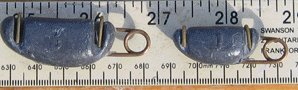
No downrigger? No problem? I don't always feel like putting out my downriggers and I have electrics! It can feel like a ton of work to hook them up and constantly move them up and down. Now don't get me wrong as this is the best way to locate fish but if you have limited hours on the water and want to fish rather than spend the day "setting up" , I suggest you use slip weights (also called snap weights) to get your lure down quick and easily. Here is the rule of thumb: 1 ounce of weight will drop your line when trolling at 2mph 6-8'. 2 ounce will take it 16-20' at 2mph and so on. When you hook them on your line, make sure the ring points down to your lure. When a fish strikes, the line will pop out and the weight will slide down to your lure and not impede your battle with the fish. A pretty simple system if you don't have down riggers or you just need a break! See picture below. March 2013.
Rainbow trout prefer clear cold water. They also thrive in large lakes (such as Okanagan Lake) with cool, deep waters. The ideal temperature range is between 55 and 60 F. They are often found at the under vegetation and around large rocks, fallen trees, or other structures. Rainbow trout are opportunistic feeders. Their diet is highly variable, with some fish seemingly taking nearly any living thing that swims by, as long as it’s small enough to engulf. In most cases, the rainbow’s diet, primarily consists of baitfish such as Kokanee (not the beer!). Fish eggs are another favorite food, particularly when rainbow trout share a body of water with stream spawning Kokanee. So how do you put this knowledge to work? #1) Find structure in the water such as quick changes in the depth of water and troll this area. #2) Use lures, plugs and bucktails that imitate different phases of Kokanee. #3) Kokanee travel in schools, equip yourself with a good fish finder and search out schools of Kokanee. If you find them...you will also find LARGE rainbows! #4) During spawning season ( early fall on Okanagan Lake) troll the mouths of major streams with BC orange Jensen Eggs.
So why do some rainbows get so large? Some rainbows can live up to 12 years! Feb 2013
When you decide to fish with the colour gold or silver in your tackle box follow this simple rule to increase your hook up rate. When the sun is out use silver. When the clouds are out use gold. Don't take my word for it...try it out! April 2011
Whether you intend to catch and release fish or not, knowing how to properly release fish is a good skill for every angler to acquire. If you plan to catch and release fish, use barbless hooks as this makes releasing of the fish much easier. Also, keep a pair of needle nose pliers handy. If you must touch the fish for any reason, wet your hands first. This helps to preserve the protective slime on the body of the fish. Failure to wet your hands may result in removing the slime resulting in the fish becoming infected with a fungus or other disease after release.If the fish has not swallowed the hook, release should be easy. If possible, leave the fish in the water and use a pair of needlenose pliers to grab the shank of the hook and twist to remove the point from the mouth of the fish. If you have an exhausted fish after a long fight and intend to release it, remove the hook, wet your hands, and hold the fish in the current with the head pointing upstream. Grip the fish just above the tail fin and gently push it forward and backward to aerate the gills. The oxygen in the water should revive the fish after a few moments. Allow the fish to gently swim away on its own steam. Jan, 2013
Scented Lures? For Real? Does it matter? You bet it does! All the oils in your skin transfer to the lures you handle. Guess what? Fish don't like the smell of humans. Did you know that anise oil is great for fishing? Anise oil actually attracts fish! A major manufacturer and distributor of fishing equipment actually rubs anise oil on their lures to improve their fish catching productivity. You can buy anise oil in the grocery store and it is perfectly fine to scent up your lure. The best part is...it smells like black licorice. Dec, 2012
There is no such thing as the all purpose rod and reel. When you are considering a rod and reel purchase, it comes down to personal choice. It’s about figuring out what type of fishing you like to do and what type of fish species you are targeting. Answering these questions first will help you select a rod and reel combination that suits the application. Jan, 2011
